
When you see a rover inching across Mars or a probe swinging by a distant moon, it’s easy to forget that nothing out there moves without a little nudge from here. Those machines aren’t freelancing; they’re following instructions sent from Earth. When NASA launched Voyager 1 and 2 in 1977, the goal was audacious: send two robots on a grand tour of the outer planets and beyond. No one then knew if they would still be operating half a century later — let alone more than 24 billion kilometers (15 billion miles) from Earth. Yet they are.
And we still talk to them.
So how exactly do we “talk” to a robot that’s millions — or even billions — of kilometres away? Spoiler: it’s not a giant walkie-talkie, and it’s definitely not Wi-Fi. Here’s how it works.
First: We Write the Instructions
Every move a spacecraft makes starts as lines of code on Earth. Engineers and mission planners figure out what needs to happen — for example: “Take a photo,” “Turn 30 degrees,” “Fire the engine for 45 seconds.”
Because there’s no undo button in deep space, these commands are tested again and again in computer simulations and, when possible, on Earth-based twins — copies of the spacecraft kept in labs. If the test looks good, the commands are bundled into a “sequence.” Think of it like packing a to-do list into a digital envelope.
Next: We Turn It into a Radio Signal
That digital envelope can’t just float through space on its own. It has to hitch a ride on radio waves — invisible ripples of electromagnetic energy. The commands are converted into patterns of ones and zeros, then carefully encoded so they can survive a long, noisy journey.
This is where timing matters. Spacecraft don’t always have their antennas pointing at Earth, and planets move. Mission teams plan when and where to send the signals so the spacecraft will actually be listening.
Beaming It Out into the Void
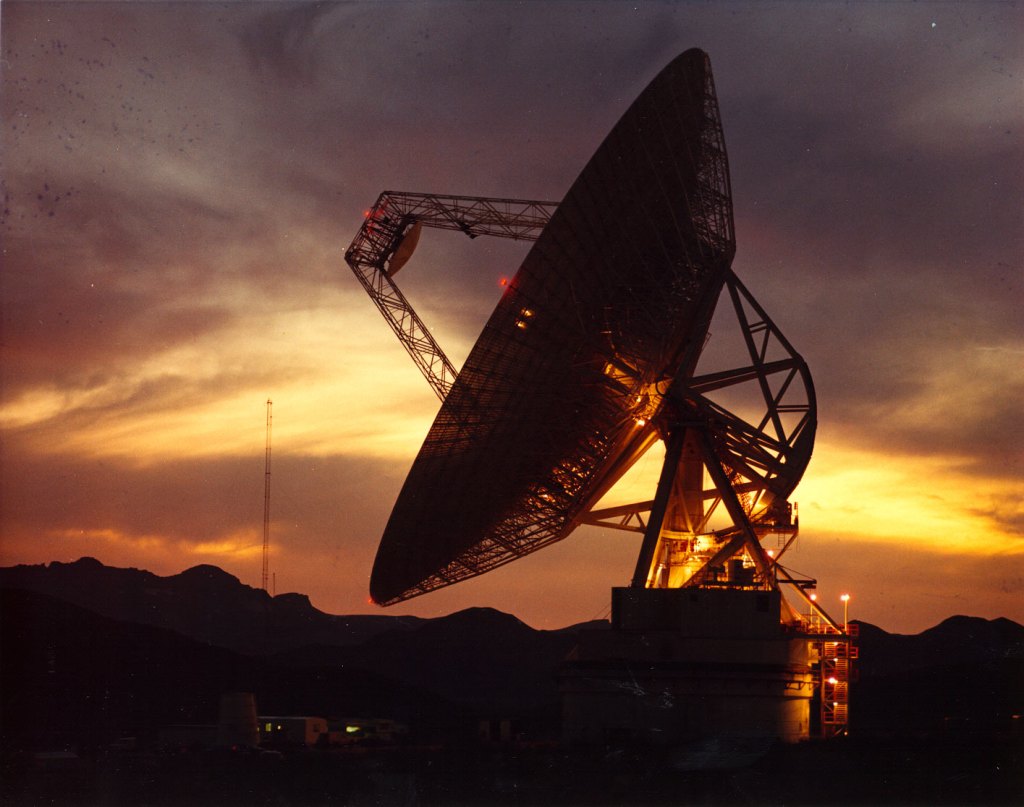
Photo: Public Domain via Wikimedia Commons
From Earth, massive dish antennas — the same Deep Space Network (DSN) dishes that catch photos coming back — blast the encoded radio waves skyward. These antennas can focus a signal like a flashlight beam aimed across the Solar System.
The signal races at the speed of light, but the distances are staggering. A command to Mars can take anywhere from about 5 to 24 minutes to arrive. A message to Voyager 1? More than 22 hours, one way.
That delay means there’s no joystick control. You can’t “drive” a rover in real time. Instead, mission teams send batches of instructions, then wait for the spacecraft to confirm it received and understood them.
The Spacecraft Listens, Checks, and Acts

Photo By NASA/JPL, Public Domain, via Wikimedia Commons
Once the radio waves reach the spacecraft’s antenna, its onboard computer decodes the data. It checks for errors (remember those carefully added correction codes), makes sure the instructions make sense, and only then carries them out.
Sometimes a spacecraft replies right away with a simple “got it.” Other times it sends a status report after finishing a sequence: photos taken, engines fired, instruments switched on or off.
Building Trust Over Light-Hours
What’s remarkable is how routine this all becomes. We’ve sent commands to Voyager probes coasting in interstellar space, to the New Horizons craft during its Pluto flyby, and to rovers navigating rocky Martian terrain — all without touching them physically.
Every successful exchange is a quiet handshake across unimaginable distance: humans thinking, machines listening, both separated by time and empty space, yet working together.
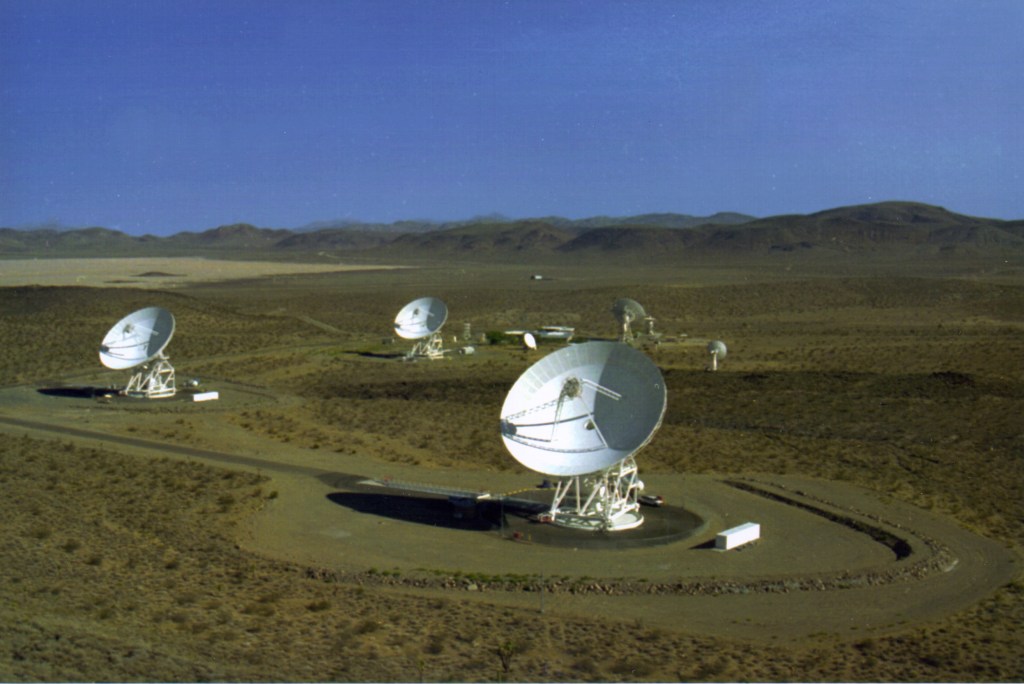
Photo By NASA – Great Images in NASA Description, Public Domain, via Wikimedia Commons
It’s not magic. It’s patience, precision, and decades of careful engineering. And every time a rover drills a rock or a probe swings past a distant moon, it’s proof that even across the Solar System, our words — turned into radio whispers — still carry weight.
 Intelligiate
Leave a comment