
If you’ve ever looked up at the night sky and wondered what everything is made of — what really lies beneath the surface of things — you’d probably get along just fine with the folks at CERN. That’s the European research centre that built the Large Hadron Collider, or LHC — a 27-kilometre underground ring that has become one of humanity’s boldest scientific experiments.
I know, “particle accelerator” doesn’t exactly sound like a weekend read. But the story of the LHC is one of ambition, teamwork, and the simple human urge to know what’s really going on under the hood of the universe.
A Brief History of an Enormous Idea
It all began back in 1954, when European nations, recovering from war, decided to rebuild their scientific muscle. They founded CERN near Geneva — a neutral zone for pure research, collaboration, and curiosity. Fast forward to the 1980s, when scientists began dreaming of a machine powerful enough to peel back the tiniest layers of matter.
By 1998, construction had started on this underground giant. Thousands of engineers, technicians, and researchers from over 100 countries joined forces to make it happen. In 2008, the LHC came alive — and a new chapter in physics began.
A few years later, in 2012, the collider did something extraordinary: it helped confirm the existence of the Higgs boson, the long-predicted particle that explains how other particles get their mass. “It’s like finding the missing piece of a cosmic jigsaw,” physicist Peter Higgs said — and he’d waited nearly fifty years to see it.
How It Works (Without the Jargon)
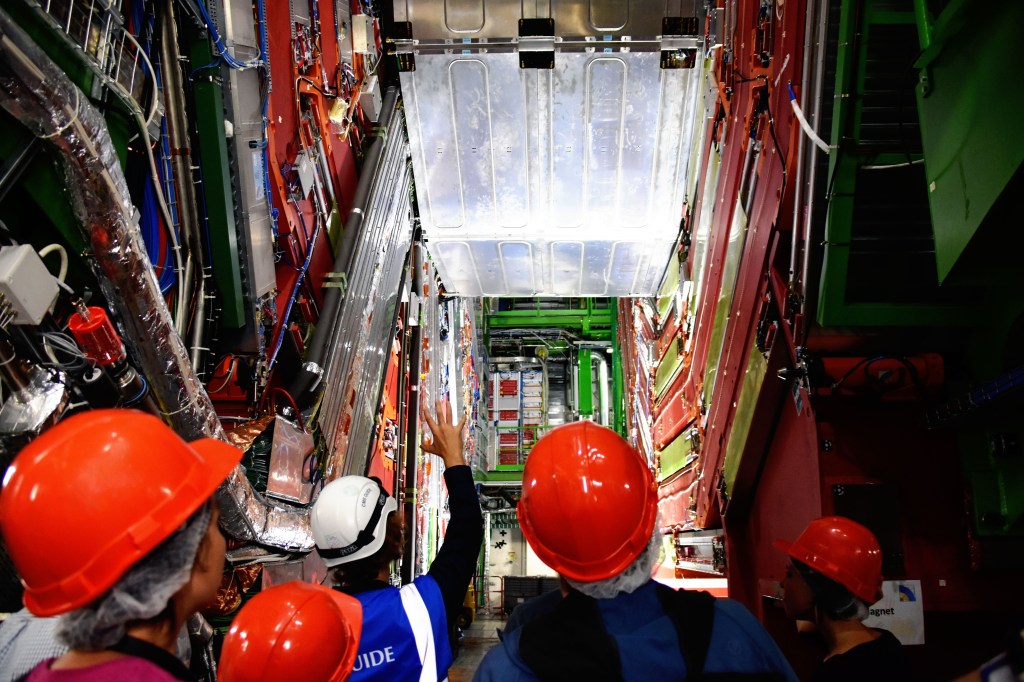
Photo: SimonWaldherr – Own work, CC BY-SA 4.0 via Wikimedia Commons
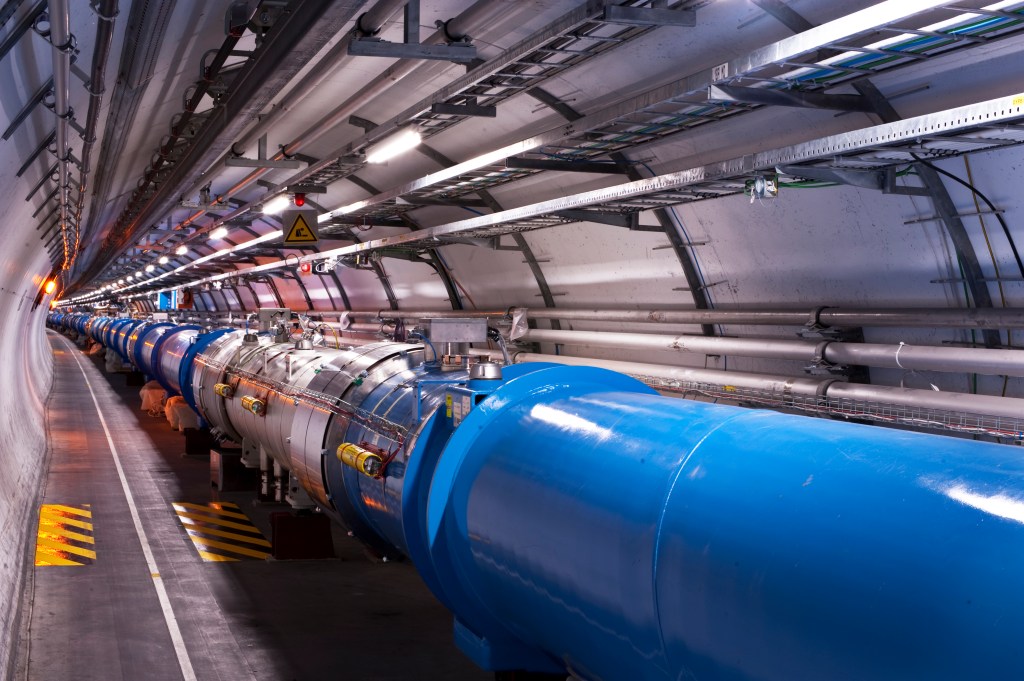
Here’s the simple version: imagine two cars racing around a circular track at insane speeds, then colliding head-on so scientists can study the debris. The LHC does something similar, except the “cars” are protons, and the “track” is a 27-kilometre underground ring straddling the France–Switzerland border.
Superconducting magnets — colder than outer space — steer the protons as they accelerate to 99.999999% of the speed of light. Once they’re going full tilt, they zip around the ring about 11,000 times every second. That’s not a typo. Eleven thousand laps a second.
When these protons finally crash into each other, the impact briefly recreates the conditions of the early universe — the moments just after the Big Bang. Detectors like ATLAS and CMS then record the flurry of particles produced, capturing traces that last for less than a billionth of a second.
It’s as if the collider smashes open the smallest building blocks of nature and then takes a cosmic selfie of the instant everything bursts apart.
Did You Know? ⚡
- The LHC’s magnets are cooled to –271.3 °C, colder than deep space.
- The energy in one proton beam equals that of a 400-ton train speeding at 150 km/h.
- Those protons circle the ring 11,000 times every second — faster than any eye or camera could ever track.
The Dividends of the LHC

Photo: ESO/P. Horálek, CC BY 4.0, via Wikimedia Commons
So, has all this cosmic racing paid off? Absolutely. Beyond the monumental Higgs boson discovery, the LHC has spun off technology that quietly improves daily life.
The World Wide Web was originally invented at CERN to help scientists share data. Research from particle detectors has led to advances in medical imaging, radiation therapy, and even data processing. Superconducting magnet tech is now being applied to energy grids and high-speed transportation.
And then there’s the knowledge dividend — the kind you can’t measure in dollars. Every new insight about how the universe holds together deepens our sense of belonging in it. As physicist Brian Cox once said, “The LHC is a cathedral to human curiosity.”
Is the LHC Dangerous?
When the collider was first fired up, a few headlines screamed about “black holes” and “end of the world” scenarios. But the reality is far less dramatic. The tiny energy densities created inside the LHC are minuscule compared to what happens naturally when cosmic rays — particles from outer space — strike Earth’s atmosphere every second.
If nature’s been safely doing this for billions of years, we can relax. The LHC isn’t tearing holes in reality — it’s just helping us peek through them.
Why It Matters
By Maximilien Brice (CERN) – CERN Document Server, CC BY-SA 3.0, via Wikimedia Commons
The Large Hadron Collider is more than a machine; it’s a statement of purpose — that knowledge is worth chasing for its own sake. It’s humanity’s way of saying, “We’re not done learning yet.”
Whether it’s helping us understand dark matter, antimatter, or the origins of mass itself, the LHC reminds us that curiosity is our oldest tool. Somewhere in those tunnels beneath Geneva, protons are still racing in circles, smashing together 11,000 times a second, whispering clues about the beginning of everything.
Personally, I believe its all worth the noise.
 Intelligiate
.jpg)
Leave a comment